
Delivery within 3-5 business days
How to use Guided rods?
Step by step instructions:
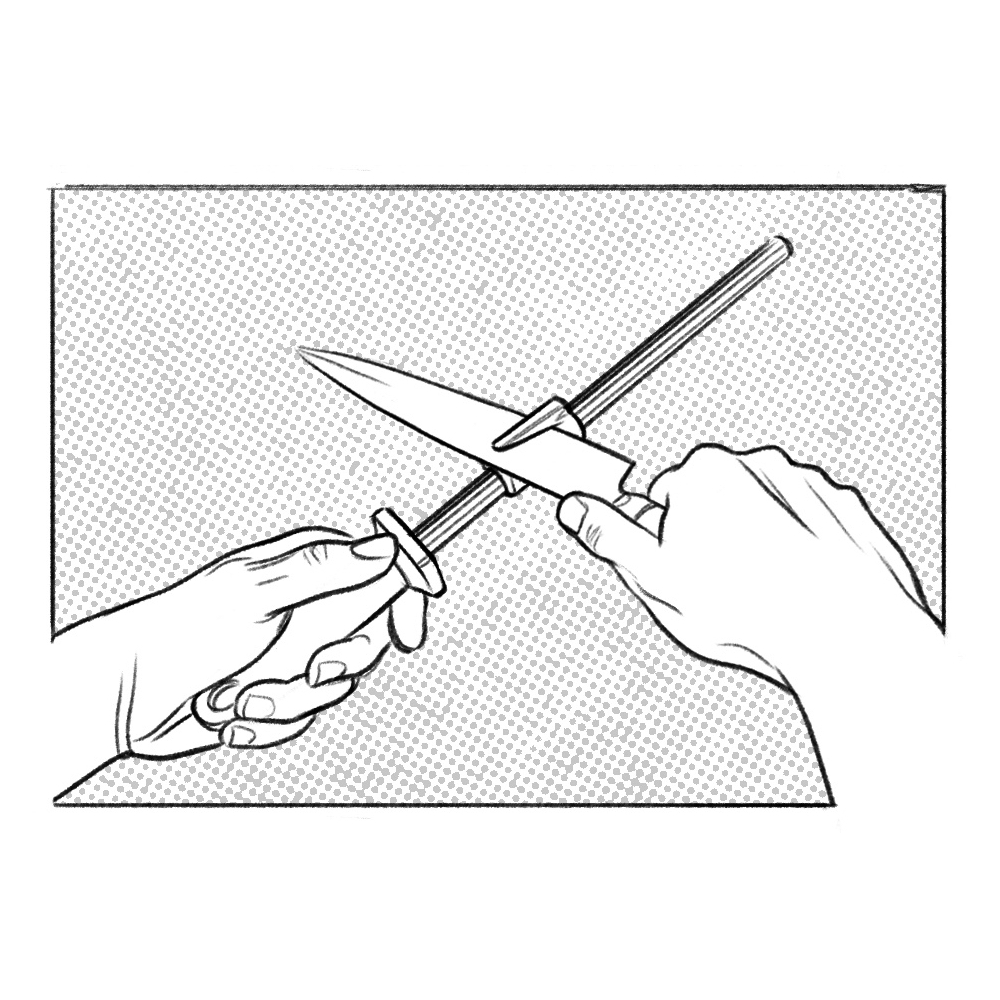
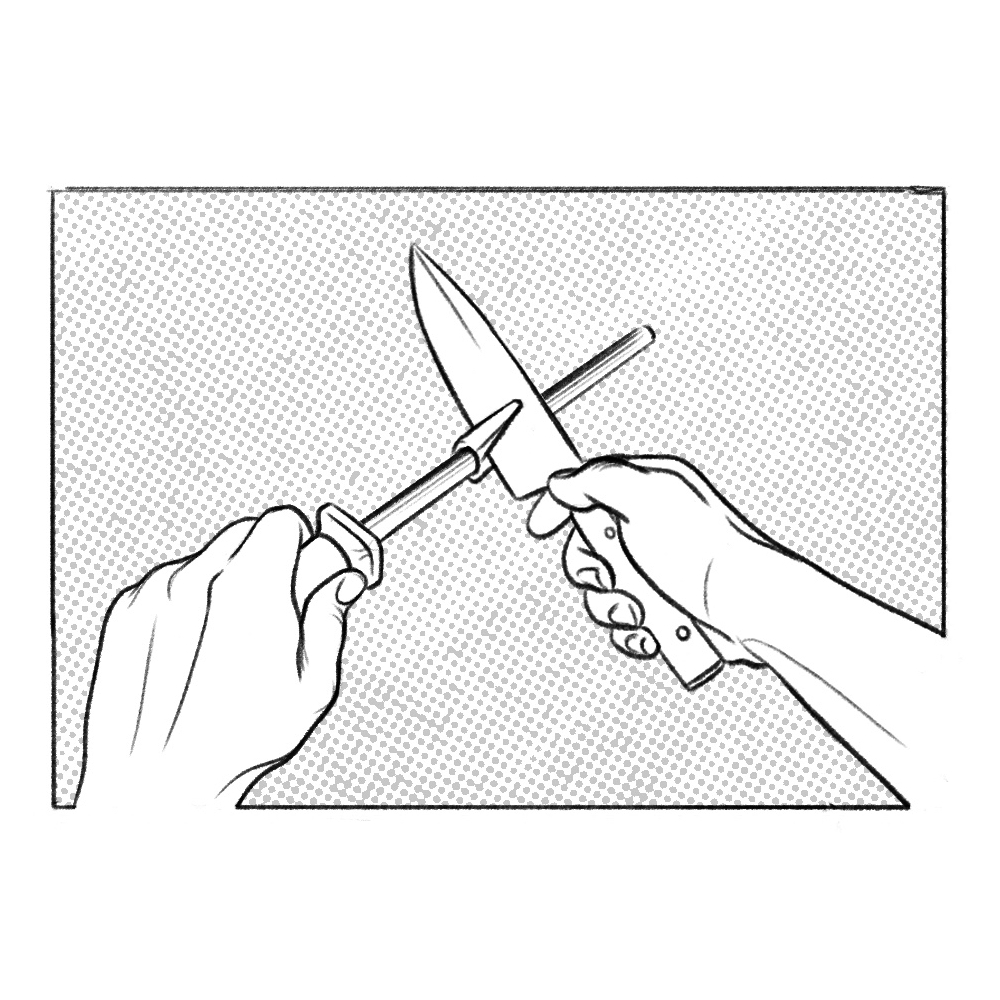
If you are right-handed, hold the rod in your left hand with your thumb on the left side of the guard. Keep the rod horizontal, and place the angle guide on the rod so that the numbers and logo are correctly positioned (not upside down).
If you are left-handed, hold the rod in your right hand, making sure the numbers and logo are not upside down.
Place the knife blade into the angle guide so that the cutting edge touches the surface of the rod and the spine rests against the upper part of the cutout.
Starting from the heel of the blade, push the knife forward along the rod until you reach the tip of the knife.
While sliding the knife on the rod, hold it at a 120-140 degree angle to the rod. This makes the sliding easier, especially if your rod is brand new and the surface is very rough.
Flip the rod 180 degrees around its axis so that your thumb is on the right side of the guard. Insert the blade into the angle guide and repeat the sliding motion along the rod from the other side. The spine of the knife should always rest against the upper part of the cutout. Sharpen the knife this way with the coarse rod until it can cut paper.
Using a fine rod and an angle guide with a larger angle removes the rough scratches left by the coarse rod, improving the quality and longevity of the edge.
When using a fine rod, apply only light pressure and gradually decrease it to a minimum toward the end of sharpening.
Check the quality of the sharpening by cutting thin paper. The slicing should now be smooth, quiet, and effortless.
Frequently asked questions
What knives can be sharpened with Guided Rods sharpeners?
This sharpener is designed for knives with full flat V-edge blade geometry with a spine thickness of up to 3 mm.
A blade may not fit the sharpening guide if is thicker than 3mm, e.g. hunting, survival or folding knives.
The sharpener can be used for thinner blades and flat blades, such as in stationery and construction knives.
Flexible or curved blades, such as in fillet knives or meat knives, can also be sharpened with this sharpener.
Using rods with angle guides teaches you to hold the sharpening angle correctly. Once you learn the skill, you’ll be able to sharpen any knife without a guide.
Are Guided Rods sharpeners suitable for all types of knife steel?
The ceramic rods used in our system are much harder than any knife steel, so our sharpener is suitable for knives made of any steel.
The harder the steel and the better the quality of your knife, the better result you will achieve with the fine sharpening rod used for finishing.
But if your knife is made of softer steel (up to 58 CHR), you will probably only need to use the coarse rod and the guide with a bigger sharpening angle.
Do you always need to use the coarse rod, or can you maintain sharpness using only the fine rod?
When it comes to high-quality steel knives, the coarse rod should only be used when your knife is fairly dull. If you sharpen your knives regularly, you can only use the fine rod until re-edging is required.
To re-edge, use the coarse rod with 30 degree angle guide and finish with the fine rod and 35 degree angle guide.
Can rods be used without angle guides?
Yes. You can use the rods without guides to sharpen knives with blade geometries that do not fit the guide, e. g. hunting, survival and folding knives.
However, using rods with angle guides teaches you to hold the sharpening angle correctly. Once you learn the skill, you’ll be able to sharpen any knife without a guide.
For which knives do you recommend using only the coarse rod with 40 degree angle guide?
We recommend using this set for knives made of relatively soft steels (up to 58 HRC). This type of steel is commonly found in knives used by most professional kitchens and people at home.
Also, some folding knives, such as Victorinox, or knives with similar blade geometry can be sharpened with this sharpening kit.
Can your guides be used with rods of other brands?
You can use our angle guides with rods of other brands if they have a circular diameter of 13.7 mm to 14 mm. Wüsthof, Zwilling and IOXIO ceramic rods will fit.
With other brands there is a chance that the guide opening will be too small or too big.
How durable are the rods and angle guides?
The rods are made entirely of ceramic and do not have any coating. Therefore, the service life is virtually unlimited. However you need to remember that ceramic is a rather fragile material and is likely to break if dropped.
The guides are made of plastic with the addition of fiberglass, which prevents them from wearing out too quickly. With normal use, the guides should last several years.
All depends on the intensity of use. For home sharpening of several knives, the guides will last a very long time.
What care is required for the ceramic rods?
During sharpening, ceramic rods become contaminated with metal particles and therefore require regular cleaning. It is advisable to clean the ceramic rod after several sharpening sessions. Dishwashing detergents and cleaning wipes are suitable for this purpose. For example, Pink Stuff wipes work very well for cleaning the rod’s surface. If using detergent and water, apply the detergent to the rough side of a sponge and clean the rod under running water.
Are rods from Guided Sharpeners compatible with the Wave sharpener case?
Yes, they are. You can use Guided Sharpener rods by removing the guide and inserting them into the holder with the handle facing up.
Get in touch
Have questions or a custom order?
Contact our customer support.